.jpg)
In the early 1940s, Woody Guthrie wrote four words on his guitar: This Machine Kills Fascists. Guitarist Stephen Mattingly treats that line as a conviction, not a slogan. Mattingly’s solo guitar album, For Whom the Bell Tolls, brings together music written in response to authoritarian violence and in praise of the compassion that resists it.
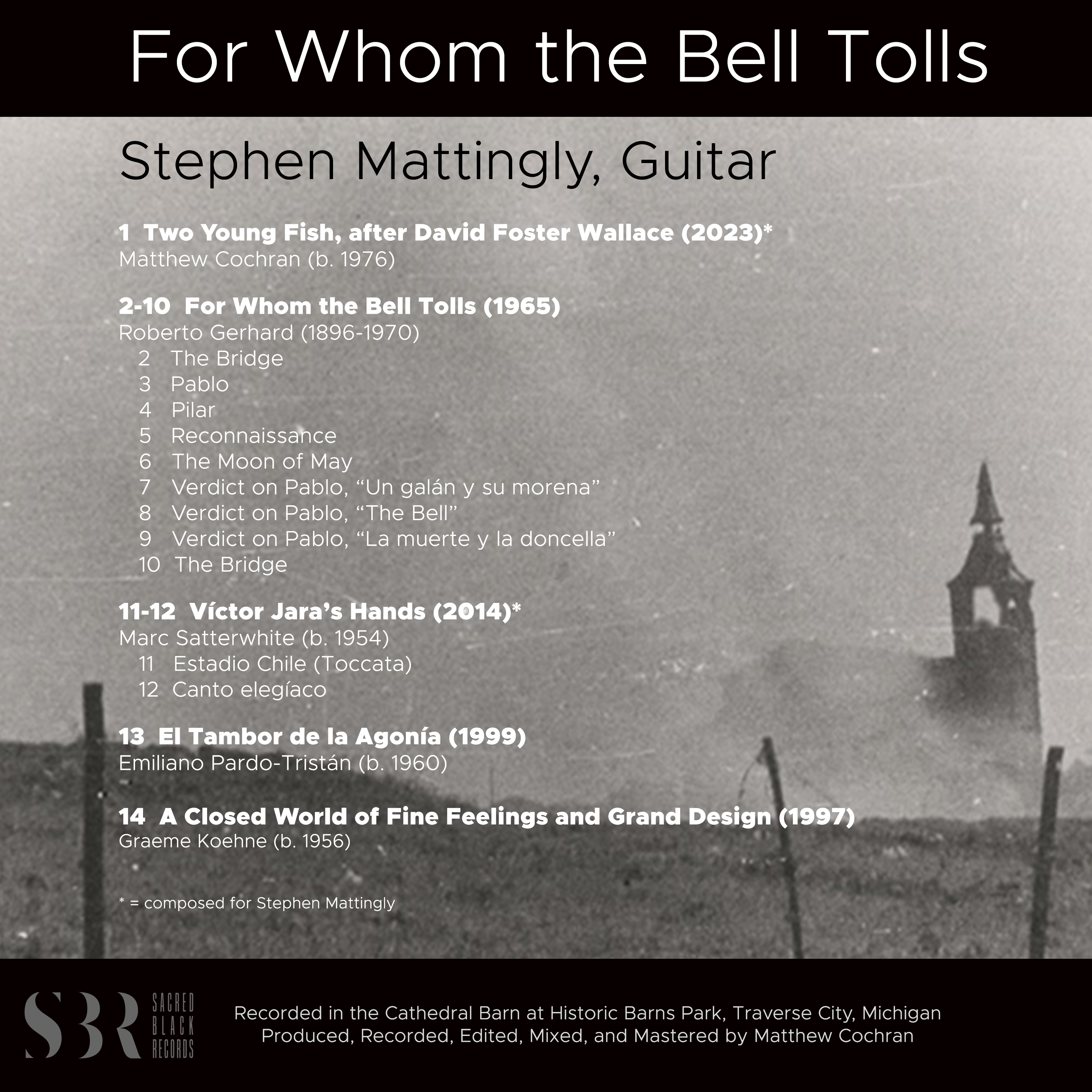
At the album’s center is Roberto Gerhard’s rarely heard guitar score for the BBC’s 1965 adaptation of Hemingway’s novel. Gerhard was driven into exile during the Franco regime, and his score is at times violent, plaintive, and aching. Gerhard’s score is answered by Victor Jara’s Hands, by Marc Satterwhite, a toccata and elegy for the Chilean singer Víctor Jara, murdered in the 1973 coup. El Tambor de la Agonía, by Emiliano Pardo-Tristán, sets a Panamanian children’s song, broken apart in memory of civilians killed in the 1989 U.S. invasion.
Two quieter works frame the program: Matthew Cochran’s Two Young Fish (After David Foster Wallace) and Graeme Koehne’s A Closed World of Fine Feelings and Grand Design. Two of the five pieces were written for Stephen Mattingly, and the Jara tribute appears here in its world premiere recording.
Mattingly dedicates the album to his father, a Marine and Vietnam veteran who, on his best days, met a world of contradictions, greed, and malice with an open mind and an open heart.
This program invites you to set aside the distractions of modernity, and courageously become more aware, more curious, and less certain about what is presented as truth. — Stephen Mattingly
Two Young Fish, after David Foster Wallace · Matthew Cochran (2023)
David Foster Wallace’s 2005 Kenyon College commencement speech opens with a joke. An older fish swims past two young ones and asks, “How’s the water?” One turns to the other: “What the hell is water?” Wallace’s point, that real education means choosing what to pay attention to and learning to care for other people, runs through Cochran’s piece. Hesitant, questioning gestures give way to long melodies surfacing over a restless current, and the music never quite settles. Keep learning, keep choosing, keep swimming. Written for Mattingly, a friend and collaborator of three decades
For Whom the Bell Tolls · Roberto Gerhard (1965)
Gerhard, a Catalan composer and student of Schoenberg, fled Spain when Franco toppled the elected Republic in 1939 and spent the rest of his life in Cambridge, England. When the BBC adapted Hemingway’s novel as a four-part series in 1965, Gerhard scored it for solo guitar. The story follows an American volunteer sent behind fascist lines to blow up a bridge. Gerhard’s music weaves in Spanish song, nods to Manuel de Falla, and two songs from his own cycle, Cantares. Hemmingway borrows his title from John Donne: “No man is an island… never send to know for whom the bell tolls; it tolls for thee."
Víctor Jara’sHands · Marc Satterwhite (2014)
Víctor Jara was one of Latin America’s most beloved singer-songwriters and a founder of the Nueva Canción movement. The day after the U.S.-backed coup of September 11, 1973, soldiers took him to the Estadio Chile in Santiago. They tortured and killed him and destroyed his hands. Satterwhite’s tribute has two movements: a toccata that suggests the coup's brutality and an elegy. He chose not to borrow Jara’s folk style, thinking it “wiser not to attempt to appropriate a musical language so different from my own.” Written for and dedicated to Mattingly; this is its world premiere.
El Tambor de la Agonía · Emiliano Pardo-Tristán (1999)
The Drum of Agony is dedicated “to the Panamanians who died in the invasion of 1989,” the U.S. military operation known as Just Cause. Human Rights Watch faulted it for an “inordinate number of civilian victims.” The title twists a favorite Panamanian children’s song, Al Tambor de la Alegría (“To the Drum of Joy”). Across six sections, from Nostalgia to Agony and Death, Pardo-Tristán fractures and rebuilds the tune, drawing on Bach, Ives, and a flash
A Closed World of Fine Feelings and Grand Design · Graeme Koehne (1997)
The Australian composer’s influences run from Chopin and Tchaikovsky to Bugs Bunny and James Bond. This piece, first written for piano, is a portrait of “a slightly naïve, wonderfully sensitive, and somewhat introverted individual.” Warm chords and a slow, broad pulse close the album with a moment of solace after everything that comes before.
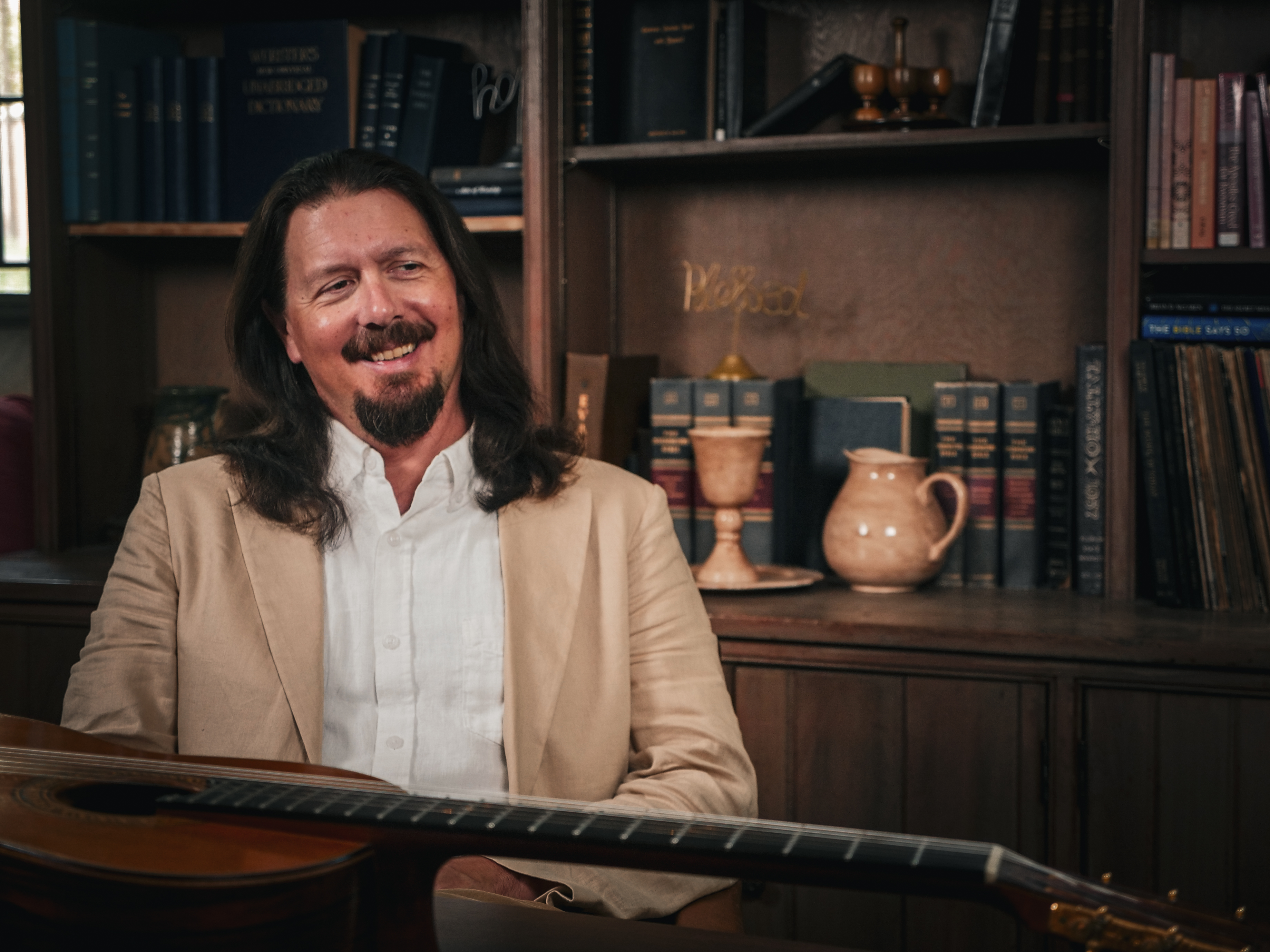
Guitarist Stephen Mattingly has performed across Europe, Africa, Asia, and the Americas, both as a soloist and as a founding member of the Tantalus Quartet. He has appeared with the Albany Symphony, Louisville Orchestra, and Orchestra Kentucky, and has given recitals from Weill Hall to major international festivals. His recording of Schubert’s complete guitar chamber works earned a Theodore Presser Award. Since 2025, he has been Associate Professor of Guitar at Florida State University. Before that, he was Professor of Guitar at the University of Louisville, where he hosted the Guitar Foundation of America convention three times. He studied at the Eastman School of Music, the Hochschule für Musik Detmold, and Florida State University.